
Report by Maizie Anders (Applied Cultural Anthropology)
From June 7 to August 18, I conducted original ethnographic fieldwork examining how coastal communities in the southern Philippines are navigating displacement and relocation nearly five years after Super Typhoon Odette (2021). My research aimed to understand how government land-use and relocation policies have reshaped everyday life for displaced fisherfolk and farmers, specifically looking at transformations in social networks, livelihoods, local power and gender dynamics, place-based attachments, and perceptions of risk. Three questions guided my fieldwork:
- What happened? What decision-making processes and power dynamics influenced post-disaster relocation and resettlement, and whose voices and interests were prioritized or excluded?
- What changed? How have government relocation policies reshaped existing social networks, everyday ways of life, and traditional livelihoods?
- Who is affected, and how? What are the gendered dimensions of displacement, and in what ways does resettlement on government land offer relief versus continued disruption?
To answer these questions, I partnered with two local fishing and farming organizations on the island of Siargao, along with a local NGO facilitating livelihood and climate-adaptation trainings. Across my fieldwork, I conducted 18 semi-structured, informal interviews with community leaders, NGO staff, displaced families, fisherfolk, and farmers. I also attended an NGO focus group with local fisherfolk and farmers on circular economies, eco-tourism, and climate adaptation.
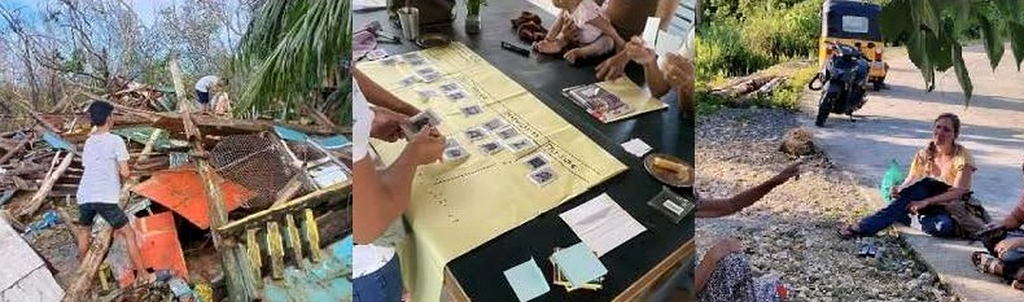
Beyond participant observation, interviews, and the focus group, I was able to immerse myself in daily life in the southern Philippines by participating in local community events and celebrations. I am extremely grateful to the CALL Uehiro Program for supporting my fieldwork this summer, and for its ongoing commitment to field-based scholarship that connects Hawai‘i with broader regional and global contexts. Mahalo nui and salamat karajaw!