
Report by Carolyn Siegman (Department of Linguistics)
With support from the Uehiro PhD Travel Award, I traveled to Montréal to present my dissertation research at the 20th meeting of Laboratory Phonology (LabPhon 20), a major international conference in my research specialization that occurs every two years. My presentation explored several aspects of speech pronunciation in Hawai‘i’s local Korean-speaking population. While several studies have noted particular changes taking place in Seoul Korean, I explored whether these changes have extended to Korean speakers who grew up in Hawai‘i but learned Korean at home from their families, referred to as “heritage speakers” in linguistics. Although a few studies have been conducted in North American Korean communities such as Toronto and southern California, no previous study has explored these language changes within the community in Hawai‘i.
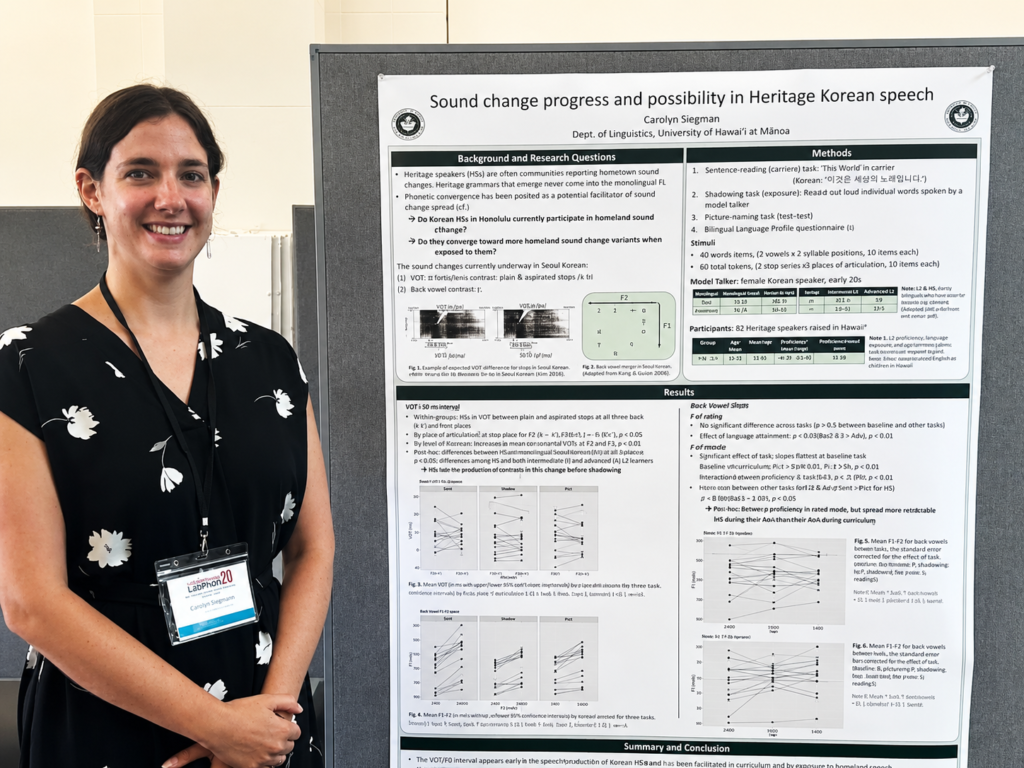
Bringing my research to this venue allowed me to build my presence in the broader academic community and introduce myself to others not only as a linguistics student, but as a researcher specializing in language change and heritage linguistics. It also allowed me to share the significance of my work with a large audience. The study of heritage speakers is still fairly new in linguistics, and much existing work describes these speakers in terms of deficiency rather than ability. At LabPhon, I contributed to a more positive representation of heritage speech studies that avoids these interpretations.
Additionally, I was able to discuss my work in person with scholars I cited directly in my dissertation research and learn about a similar project in Philadelphia that is related to mine. I was also able to introduce myself to several established professors and become part of the academic community beyond my department. Through these conversations, I learned about different kinds of post-doctoral opportunities, which is incredibly helpful as I plan my next steps after graduation. By attending other scholars’ talks, I saw research on heritage speakers that shared the same framework I used and learned more about the latest developments in laboratory phonology more generally. Learning about this work gave me several new ideas for future research projects I can explore after my dissertation. Overall, presenting at LabPhon furthered my professional presence in several ways at once, and it occurred at a crucial point in my PhD program.